
Category: Business

  • Navigating The Global Market: The Best CRM Software For UK Expat Businesses

    Navigating The Global Market: The Best CRM Software For UK Expat Businesses

    Introduction: The Borderless British Entrepreneur

    In an increasingly interconnected global economy, British expatriates are establishing ventures across every corner of the globe. From the bustling tech hubs of Singapore and Dubai to the creative enclaves of Europe and North America, UK expat businesses are thriving. However, operating a business outside the United Kingdom brings a unique set of challenges. Managing cross-border transactions, keeping up with diverse regulatory frameworks, coordinating with teams across different time zones, and maintaining strong relationships with customers worldwide can quickly become overwhelming.

    To manage this complexity, selecting the right digital tools is paramount. Central to any modern digital infrastructure is the Customer Relationship Management (CRM) system. When it comes to navigating the global market, the best CRM software for UK expat businesses must be agile, secure, highly customizable, and capable of operating effortlessly across borders.

    This comprehensive guide explores the unique challenges faced by UK expat business owners, outlines the essential features of a globally optimized CRM, and reviews the top software solutions available on the market today.

    The Unique Operational Challenges of UK Expat Businesses

    Unlike localized enterprises, UK expat businesses operate in a multi-layered ecosystem. They often retain deep connections with the UK market—including clients, suppliers, and regulatory compliance requirements—while simultaneously engaging with local markets in their country of residence. This duality introduces several friction points:

    • Multi-Jurisdictional Compliance: Businesses must simultaneously comply with the UK’s General Data Protection Regulation (UK GDPR) and local privacy laws (such as CCPA in California, or PDPA in Singapore).
    • Currency Fluctuations & Multi-Currency Management: Transactions are often conducted in Great British Pounds (GBP), local currencies, and major global currencies like USD or EUR.
    • Temporal Dispersal: Managing communication workflows across varying time zones without delays in client response times.
    • Dispersed Teams: Managing remote or localized workforces that require seamless, cloud-based collaboration tools.

    To overcome these hurdles, expat entrepreneurs require more than just an address book software; they need a localized hub with global reach.
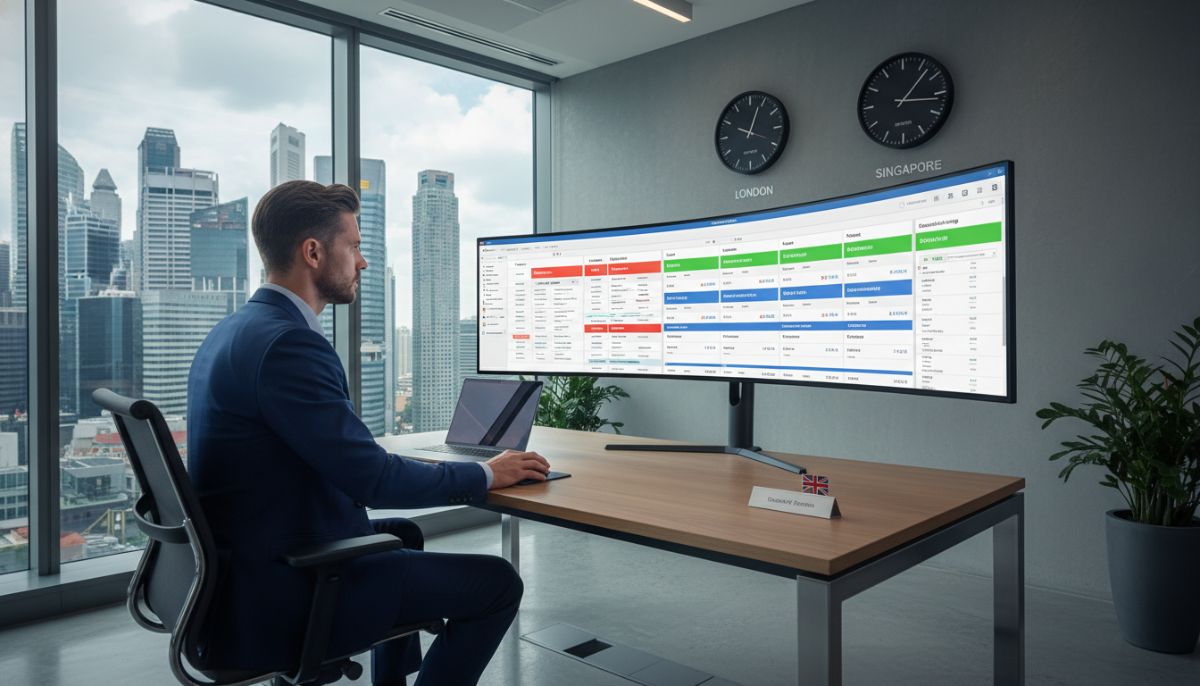
    A professional UK expat working in a modern high-rise office in Singapore, analyzing CRM visual pipelines on a large screen monitor, with London and local time zone clocks visible on the wall, professional corporate aesthetic.

    Critical Features of a CRM for Global Operations

    Before selecting a CRM platform, expat business owners must evaluate specific functionalities that facilitate frictionless international commerce. A standard, single-region CRM will simply not suffice.

    1. Robust Multi-Currency and Localization Support

    Your CRM must support automatic currency conversion rates and allow deals to be tracked in multiple currencies. This ensures accurate forecasting and reporting, enabling you to see your global pipeline converted back to GBP or your local operational currency in real time.

    2. GDPR and International Data Compliance

    Because you are a UK expat, you likely handle data belonging to UK and EU citizens. The CRM must offer built-in compliance tools, such as automated consent tracking, secure data hosting options (such as UK or EU-based cloud servers), and simplified data erasure protocols to adhere strictly to the UK GDPR.

    3. Integrated Global Communication Channels

    When operating globally, standard telephony is often cost-prohibitive. The ideal CRM must integrate seamlessly with international VoIP providers, email clients, and global instant messaging platforms like WhatsApp, WeChat, or Slack, centralizing all communication history.

    4. Advanced Automation across Time Zones

    Automation rules should be timezone-aware. Sending an automated follow-up email at 3:00 AM local time to a premium London client looks unprofessional. Your CRM should schedule workflows based on the recipient’s localized time zone.

    Comparative Analysis of the Top CRM Systems for Expat Businesses

    To assist your selection, we have analyzed the top five CRM systems suited for UK expatriate enterprises. The following table provides a high-level comparison of these leading platforms:

    CRM Platform Best Suited For Key Global Feature Multi-Currency Support GDPR Compliance Tools Ease of Setup
    HubSpot CRM Inbound marketing & scaling businesses Deep localization & native content management Yes (Enterprise & Professional Tiers) Excellent (Dedicated EU/US data centers) High
    Zoho CRM Cost-conscious and highly customized setups Extensive multi-currency processing & localized feeds Yes (All paid tiers) Robust configuration required Medium
    Salesforce Enterprise-grade, complex multinational operations Unparalleled global customization and API integrations Yes (Advanced multi-currency setup) Highly compliant & certified globally Low (Requires specialist setup)
    Pipedrive Sales-focused, pipeline-centric micro-businesses Visual deal tracking and clean time-zone scheduling Yes (Advanced and above) Good Very High
    Monday.com CRM Collaborative teams and hybrid workflows High visual customization for remote global teams Yes (Via custom integration formulas) Good High

    Deep Dive: The Leading CRM Solutions Evaluated

    HubSpot CRM: The King of Scale and Inbound Marketing

    HubSpot stands out as a premier choice for UK expat businesses that rely heavily on digital marketing, content generation, and inbound lead acquisition. Its highly intuitive interface ensures that distributed teams can adopt it with minimal training.

    One of HubSpot’s key strengths for global operations is its multi-language capabilities. You can manage localized websites, landing pages, and email campaigns in dozens of languages from a single portal. Additionally, HubSpot’s robust compliance features make it easy to adhere to UK GDPR requirements, offering automated cookie consent banners and opt-in/opt-out directory structures.

    Zoho CRM: The Value-Driven Customization Powerhouse

    For expat business owners who need enterprise-level customization without the enterprise price tag, Zoho CRM is an exceptional choice. Zoho offers a comprehensive suite of business applications (Zoho One) that integrates flawlessly with its CRM.

    Zoho supports multi-currency transactions across all paid tiers, permitting companies to establish a base currency (e.g., GBP) while executing transactions in local currencies (e.g., AED, SGD, or USD). Its built-in AI assistant, Zia, helps predict sales trends and identifies anomalous transactions, which is invaluable when dealing with volatile exchange rates and diverse markets.

    “In the modern digital economy, a CRM is no longer merely a system of record. For the UK expat entrepreneur, it functions as the central nervous system of their borderless enterprise, bridging cultural, geographical, and temporal divides.” — Global Enterprise Technology Analyst

    A conceptual digital artwork representing global connectivity, showing a stylized map of the world with glowing data nodes connecting London to Dubai, Hong Kong, and New York, symbolizing seamless cross-border business relations.

    Salesforce Sales Cloud: The Unrivaled Enterprise Benchmark

    If your expat business is scaling rapidly, handling massive transaction volumes, or managing a highly complex corporate structure, Salesforce is the gold standard. Salesforce is capable of handling any level of customization required for global trade.

    Its “Advanced Multi-Currency” feature allows users to track conversions, manage corporate exchange rates, and review complex financial analytics across various global regions with precision. However, Salesforce is highly complex and typically requires a certified developer or consultant to set up and maintain, making it less suitable for solopreneurs or very small teams.

    Pipedrive: The Sales Professional’s Best Friend

    For smaller expat ventures, particularly those focused on outbound sales pipelines and lead nurturing, Pipedrive offers a streamlined, visual approach. Its focus is entirely on keeping deals moving through the sales funnel.

    Pipedrive is highly favored by expat business owners who operate as solopreneurs or manage micro-teams. Its setup is incredibly fast, and its timezone integration ensures that scheduling client calls and meetings across continents is flawless, preventing embarrassing scheduling conflicts.

    Strategic Implementation: How to Deploy Your Global CRM

    Choosing the right software is only half the battle; proper implementation determines success. When deploying your selected CRM system across borders, consider the following strategy:

    Phase 1: Establish Your Data Architecture

    Before inputting a single lead, decide on your base currency and your data residency policies. If your primary customer base is in the UK, choose a CRM provider that allows you to store your database in a UK or European data center to ensure optimal GDPR compliance and minimize latency.

    Phase 2: Standardize Data Entry Rules

    When managing a distributed team, standardized data entry is critical. Create strict rules for inputting international telephone codes, localized physical addresses, and regional client tags. Consistency in your database is what enables clean global reporting.

    Phase 3: Train Remote Teams Globally

    Conduct comprehensive onboarding sessions tailored to the time zones of your remote employees. Leverage video training resources and centralized documentation so that team members can learn synchronously and asynchronously, regardless of where they are in the world.

    Conclusion: Selecting the Perfect Fit for Your Expat Journey

    Navigating the global market requires resilience, adaptability, and the right technological framework. For UK expat businesses, a CRM is not a luxury—it is an absolute necessity for survival and growth.

    If your business is heavily focused on marketing and scale, HubSpot offers the most comprehensive, polished ecosystem. For highly customized, budget-conscious setups, Zoho CRM provides unmatched value. If you run a high-volume, complex enterprise, Salesforce remains the industry standard, while Pipedrive is the ideal partner for agile, sales-centric small businesses.

    By carefully aligning your CRM choice with your specific cross-border operational needs, you can streamline your global workflows, ensure strict regulatory compliance, and position your UK expat business for long-term international success.


  • Navigating The UK Business Visa Landscape: A Comprehensive Guide For Global Entrepreneurs

    Navigating The UK Business Visa Landscape: A Comprehensive Guide For Global Entrepreneurs

    Introduction

    The United Kingdom has long stood as a beacon of commerce, innovation, and economic stability. For global entrepreneurs, the British market offers an unparalleled ecosystem defined by access to robust capital markets, a highly skilled workforce, and a progressive regulatory environment. However, establishing a commercial presence in this dynamic nation requires a clear, strategic understanding of the immigration gateway. Navigating the UK business visa landscape is the critical first step for any international founder or business leader aiming to leverage these opportunities.

    Following significant regulatory overhauls in recent years, including the transition to a post-Brexit points-based system, the UK immigration framework has become more selective yet strategically aligned with high-growth industries. This comprehensive guide serves as a strategic roadmap for global entrepreneurs, detailing the primary visa pathways, key compliance metrics, and practical steps to ensure a successful application.

    A professional modern office in London with the Tower Bridge visible through the floor-to-ceiling glass windows, a diverse group of entrepreneurs in business attire discussing over a tablet, bright natural lighting, corporate style

    Understanding the Modern UK Business Visa Landscape

    In April 2023, the UK Home Office enacted sweeping changes designed to simplify business routes while elevating the quality of inbound enterprise. The retirement of the traditional Start-up and Innovator visas paved the way for more streamlined routes. Today, the focus has shifted firmly toward attracting genuine innovation, scalability, and high-value skills.

    To successfully navigate this landscape, global entrepreneurs must align their business objectives with the specific criteria of the UK’s tailored visa routes. The points-based system awards points for English language proficiency, financial viability, and endorsement from approved external bodies, shifting the decision-making process from bureaucratic box-ticking to holistic business assessment.

    “Success in the UK market depends not just on a groundbreaking business model, but on aligning that model seamlessly with the UK Government’s strategic immigration priorities. Regulatory alignment is as crucial as product-market fit.”

    Primary Visa Routes for Global Entrepreneurs

    1. The Innovator Founder Visa

    Designed for experienced entrepreneurs looking to establish an innovative, viable, and scalable business in the UK. The most significant update to this route is the removal of the previous £50,000 minimum investment funds requirement, provided the applicant has a genuinely innovative concept approved by an official Endorsement Body.

    • Key Requirement: The business concept must be unique, offering something not currently available in the UK market. It must have a structured plan for job creation and scale.
    • Endorsement: Applicants must secure an endorsement letter from an approved body (such as Innovator International, UK Endorsement Services, etc.) before applying for the visa.
    • Settlement Path: This route offers an accelerated path to Indefinite Leave to Remain (ILR) in as little as three years if specific business growth milestones are met.
    • 2. The UK Expansion Worker Visa (Global Business Mobility)

      For established overseas businesses looking to expand their footprint by setting up their first UK branch or subsidiary. This route replaces the old Sole Representative of an Overseas Business visa.

    • Key Requirement: The applicant must be a senior manager or specialist employee who has worked for the overseas business for at least 12 months (unless earning over £73,900 or meeting nationality exemptions).
    • Sponsorship: The overseas business must apply for and obtain a sponsor license before sending its representative.
    • Settlement Path: This route does not lead directly to settlement, though visa holders can transition to other qualifying routes (such as Skilled Worker) once in the UK.
    • 3. The Scale-up Visa

      Introduced to support rapidly growing UK businesses, this visa is ideal for highly skilled global talent and entrepreneurs who have been recruited by an authorized UK scale-up sponsor.

    • Key Requirement: The sponsoring UK company must demonstrate annual growth of at least 20% in either turnover or employment over a three-year period, starting with a minimum of 10 employees.
    • Flexibility: After 6 months of sponsored employment, the visa holder can transition to an unsponsored status, offering unparalleled professional flexibility.
    • 4. The Global Talent Visa

      For exceptional individuals in science, engineering, medicine, humanities, digital technology, or arts and culture who are recognized as current or potential leaders in their fields.

    • Key Requirement: Endorsement by a designated competent body (e.g., Tech Nation for digital tech, the Royal Society for science).
    • Flexibility: No sponsorship is required, and visa holders can work for any employer, start their own business, or work as a freelancer.
    • A conceptual close-up of a UK passport, visa application forms, and a laptop showing financial growth charts, representing successful UK business visa navigation, high depth of field

      Comparative Analysis of Key Business Visa Routes

      To assist global entrepreneurs in making an informed decision, the table below outlines the core requirements, investment thresholds, and settlement opportunities across the primary routes:

      Visa Category Minimum Investment Endorsement/Sponsorship Required? English Language Requirement? Path to Indefinite Leave to Remain (ILR)?
      Innovator Founder No minimum (must prove sufficient setup funds) Yes (By an approved Endorsement Body) Yes (CEFR Level B2) Yes (Accelerated 3-year route)
      UK Expansion Worker None Yes (Sponsor License from parent company) No No (Must switch routes to settle)
      Scale-up Visa None Yes (By an approved UK Scale-up business) Yes (CEFR Level B1) Yes (5-year route)
      Global Talent None Yes (By a Designated Endorsing Body) No Yes (3 to 5-year route)

      Step-by-Step Strategic Framework for Application

      Navigating the UK business visa landscape requires meticulous planning. Global entrepreneurs should follow this structured approach to maximize their chances of a successful application:

      Step 1: Market Research and Feasibility Analysis

      Before choosing a visa route, ensure there is a clear market demand for your product or service in the UK. This research forms the backbone of the business plan required by endorsing bodies.

      Step 2: Formulating a Compliant Business Plan

      For the Innovator Founder visa, your business plan must explicitly address three pillars:
      1. Innovation: Is the business offering a genuine point of difference?
      2. Viability: Does the business have a realistic, sustainable financial model?
      3. Scalability: Is there potential for structured job creation and national/international growth?

      Step 3: Securing Endorsement or Sponsorship

      Apply to an approved endorsing body or secure your corporate sponsor license. This step is often the most time-consuming and requires extensive documentation, legal audits, and sometimes pitches.

      Step 4: Meeting the Personal Criteria

      Gather necessary personal documentation, including tuberculosis test results (if applicable), proof of English language proficiency, and evidence of maintenance funds to support yourself and any dependents.

      Step 5: Final Submission and Biometrics

      Submit the online application via the official UK Government portal, pay the Immigration Health Surcharge (IHS) and application fees, and book a biometrics appointment at your local Visa Application Centre (VAC).

      Common Pitfalls to Avoid

      Even highly successful global entrepreneurs encounter obstacles during the UK immigration process. Understanding these common pitfalls is essential:

    • Submitting a Generic Business Plan: Endorsement bodies analyze hundreds of applications. A template-based business plan that fails to show deep knowledge of the UK competitive landscape will be rejected immediately.
    • Underestimating Financial Requirements: While some visas do not have a minimum investment threshold, applicants must still prove they have sufficient capital to launch and sustain the business until it reaches profitability.
    • Incorrect Document Formatting: The UK Home Office has strict rules regarding the age, format, and translation of financial and identity documents. A minor administrative error can lead to a costly visa refusal.
    • Poor Timeline Management: Visa processing times can vary significantly depending on the time of year and geographical location. Failing to account for processing backlogs can disrupt corporate launch timelines.

    Conclusion

    Navigating the UK business visa landscape requires global entrepreneurs to balance bold commercial ambition with rigorous regulatory compliance. While the UK’s modern points-based system is highly structured, it rewards genuine innovation, high-level skills, and sustainable economic contribution. By choosing the correct immigration route, formulating a robust, compliant business strategy, and paying close attention to administrative details, international founders can successfully establish their presence in one of the world’s most lucrative and dynamic markets. Secure your gateway, plan with precision, and unlock the immense potential of the UK business ecosystem.